Showing posts with label Career. Show all posts

Tuesday, 1 December 2020

My Life in Music - An Interview with Vic Rust


Back in 1997, when Titanic was released into cinemas, I remember seeing an interview with the film's director James Cameron in which he said there is no point in retelling a story unless you are going to cover new ground! Cliff told me much the same when recording a cover version of an original hit, whether one of his own or by another artist. It has to be different to what's gone before. That is certainly true of Vic Rust's book on Cliff's recordings, which was published almost twenty years after me and Peter Lewry had researched, written and published our book on Cliff's recordings sessions. What Vic's book did was go one stage further by literally discussing and analysing every song Cliff had recorded in detail, something the sessions book didn't cover! The result was a very different book.

Although most would consider Vic a researcher and writer, he himself considers himself a musician with good reason! In a recent conversation I had with him, he told me why, and when looking back on his past, it's easy to understand.

As Vic told me, he grew up with music all around – quite literally. "My father, Brian, was the foremost vintage jazz and popular dance music discographer, who worked from home, had a weekly radio show on the fledgling Capital Radio, and regularly wrote sleeve notes, articles and reviews for a wide variety of labels and artists and genres. The point is that I can’t really remember a time when there wasn’t some sort of music – usually his beloved jazz – playing as the soundtrack to my youth."

Vic was born in the year when Cliff Richard’s Summer Holiday was packing them in at cinemas across the country, and Gerry and the Pacemakers were at number one with How Do You Do It? (curiously enough, his twin sister has no interest in performing music, although she does like listening to pop music. Vic's musical tastes are wide and varied, so maybe this adds a footnote to the nature versus nurture debate?)

"Because of my dad’s job, I was steeped in music from birth, so it came as no surprise to me (on reflection) that my future would be welded firmly to the art. My earliest clear musical memory was overhearing a record that my dad happened to be reviewing, and which stopped me in my tracks as I listened enthralled. I crept into my dad’s study and sat on the shabby visitor’s chair and asked if he could play it again. And again. I loved the sound of the guitars, the timbre of the lead singer’s voice, the blending of the exquisite harmony vocals and the perfect rhythm... That record was Blue Turns to Grey by Cliff and the Shadows and it holds a special place in my heart because it set me on the course that has culminated in what I’m doing today - researching and writing!

"My upbringing was unconventional from the point of view that my dad worked from home and drip-fed me music, when I went to school, it was a source of immense confusion to realize that no-one else’s father in my class did the same thing, but it also helped me to understand how fortunate that, by dint of hard work and steel-eyed focus, he was able to make a living out of doing what he loved. And it sowed the seeds for me to consider it as a sideline in my later life, although it was not something that I was immediately conscious of. Instead, I became a voracious consumer of the records that my parents had in their collection, from the performances of classics of Beethoven, Bach, Rachmaninov, Debussy and so on to the comedy gold of Allan Sherman’s parodies, Flanders and Swann, Peter Cook and Dudley Moore, Anna Russell and Victor Borge.

"And, in between, I listened avidly to the radio, swept up in the joy of the welter of popular music, and especially rock and roll and its derivatives. At the same time, there were some fantastic books being published, such as The Guinness Book of British Hit Singles. I read it from cover to cover, such was the thrall the information had over me, and I started looking for patterns and cross-referenced information, writing lists of the bits of details that weren’t in there, such as the composers of the titles. It was my first toe-dip into the world of research (in the days when the local library was the source rather than the ease of the internet today).

At the same time, it was established that I had a rather good treble voice. Inevitably, I was pushed by my mother to audition for the local church choir – hated that bit, but I loved the performance of some of the most powerful choral pieces in the world. As I started secondary school, it was obvious that I was going to join the school choir, and I was deemed to be good enough to be asked to be part of the more elite Motet Choir, which afforded me my first journey out of England as we toured Germany.

"At home, music enveloped me every waking hour as usual, not the least because I had taken up learning to play the piano, clarinet and guitar – although not simultaneously! And my dad still received records and tapes on a regular basis to review. Once he’d done that, he passed them over to us and I would happily sit listening to them, reading the liner notes, the composers, the music publishers, copyright notices, everything was important and interesting to me! I remember when World Records produced a six-disc boxed set called The Cliff Richard Story, that was all I played for a fortnight, as I was introduced to not only Cliff’s early work, but also to the Shadows’ witty and wonderful instrumentals.


"But I also found another skill, which would help me in my future career – I could identify what an instrument was, even in an ensemble performance. My dad recognized this and I was pulled in to help him in his research for his books on jazz and dance music. “Was that a pizzicato violin or a banjo?” I remember my dad smiling with pride when I was able to identify the instrumentation. I also helped him sift through poorly-written session cards from RCA and EMI that were falling apart to pluck out the key pieces of information. There was nothing so exciting as seeing my name written in a proper book for the first time!

"I’ve always been a sucker for a great harmony and especially where they are performed using the human voice (this is why Cliff is especially appealing – he does such a great line in vocal harmony). So I jumped at the chance to be a founder member of a barbershop group (there were around twelve of us, so think Kings Singers), which was called The Calico Consort (after a piece we performed at the first concert called Calico Pie and because of its alliterative qualities). What set this apart from the school choirs was that it was more intimate – no instrumentation to support us and the opportunities for solos. It was also cheap to put on gigs!

"In the summer of 1981, just as the incumbents were about to fling themselves into higher education at university, the group went on tour to Germany. It was a great experience (even though I had severe laryngitis on the last day) and we were sad to bid farewell to the Calico Consort. Then I had the idea of going into the recording studio to set some of our repertoire down for posterity. This was where my fascination with records and the recording process was given a further fillip. In the September, I had organized three evening sessions for the group at a local studio. I was in the role of performer, soloist… and producer. I just loved sitting behind that mixing desk and working through the tapes and putting the record, Patchwork, together. So much fun was had – particularly where I was concerned – we agreed to get together each year for performances and it spawned two further records with me in the production chair – Moonlight and Magnolia and Calico Christmas.

While I was at university in Colchester, naturally one of the clubs I joined was the University of Essex Choir, which put on a performance at the end of the first and second semesters. This was where I met Richard Cooke, who directed the performances and was also the newly-appointed director of the London Philharmonic Choir. I had subsidized vocal coaching from him and, as a result, when I applied to join the LPC after university (as far as I know) I was the only member who didn’t have to go through the audition process.

"What the experience afforded me opened up completely new and exciting worlds for me. I remember the first time I went through the stage door at the lovely Royal Albert Hall, performing at the BBC Proms, appearing on television for the first time, looking out at the audience at the Royal Festival Hall, singing solos… the adrenalin rush was phenomenal and I was smitten.

"But the best part of it was my involvement in so many different recordings, nearly all of them in Studio 1 at Abbey Road, and occasionally in the hallowed quietness of Studio 2, where the Beatles and Cliff and the Shadows had laid down the majority of their tracks until the seventies. I was fascinated and a little over-awed. It was this experience that fed into some of the plot of Puppet on a String.

Unfortunately, life kind of got in the way and, in the mid-nineties, I had to leave the choir. I was the Business Manager then, but rehearsing and recording and performing in London, living in Kent and having a day-job at Heathrow Airport was just too much stress and, after much heart-searching I left.

"I was in the Tonbridge W. H. Smiths when I found The Complete Recording Sessions by Nigel Goodall and Peter Lewry. I had maintained my interest in Cliff’s music and the minutiae of his recording process and resultant records, so it was as if this book had been specifically written for me.

"I wrote a couple of novels and then worked on The Moody Blues Encyclopaedia as an exercise in maintaining my interest in research and writing. It also gave me an unnecessary excuse to listen to music at every opportunity! Come 2009, the world was in financial straits and I took the opportunity to abscond from Heathrow and take redundancy.

"It allowed me to focus on my next project, which became The Cliff Richard Recording Catalogue, helping me to visualize Cliff and the Shadows recording in Abbey Road and how the records were developed. And that has largely been my life for just over a decade. Having interviewed Cliff on a number of occasions, Nigel invited me to submit the sleeve notes for Cliff's 2017 Stronger Thru the Years album as he felt I was better suited to write what Warners wanted than he was, which culminated in being asked to write the discography appendix for his 2020 autobiography, The Dreamer. I have made great friends with the Cliff community, and, in particular, with Nigel, who has been so helpful with background information from his time as co-curator of Cliff’s EMI back catalogue."


Vic is often asked if he has finished with his work on documenting Cliff's recordings! Like Ernst Jorgensen who looks after Elvis Presley's catalogue, the answer in no! Not as long as Cliff continues to release singles and albums, there will always be something to write about, and collect more information to add to what would be the fourth edition of his book. As long as there is a market for more editions of his most successful book, then his work won't be finished! And it's not just confined to Sir Cliff! He is currently working on an Olivia Newton-John recording catalogue, and along with me and Juliette from Leo's Den is involved with our joint plight to get Cliff and Olivia's long lost 1972 TV special, The Case, released on DVD and Blu ray. And despite his fascination to write about Cliff's recordings, he still considers himself a musician at heart, but now a musician who writes about music!

Vic Rust is the author of The Cliff Richard Recording Catalogue, and the editor-in-chief of the charity book, Thank You for a Lifetime – To Sir, with Love.

Thursday, 25 June 2020

The Story Behind Elvis' 18th #1


When l was asked by BMG in early 2002 to provide a track and discography history for Elvis' recording of A Little Less Conversation, I was surprised that they were asking me and not their Elvis catalogue producers and curators, Ernst Jorgensen and Roger Semon. What they really wanted to know was where the alternate vocal version featured in the Ocean's Eleven movie had come from. Even more surprising was that they were planning to release it as a new single. It was surprising because the original track had been a mediocre movie song that was released without much attention being paid to it! Of course that was before it had been remixed by JXL as a dance mix, had been sent out as a 12-inch advance promo to clubs for DJs to test club goers reaction to it and got picked up by Nike for their inescapable FIFA Word Cup advertising campaign, so I told them what I knew, and had been asked to research!

What I came up with was this ... the original single version was released in November 1968 with Almost In Love on the B-side. In the US, the single had been released two months earlier with both sides reaching the Top 100 at #69 and #95 respectively. In the UK, without any official cinema release of Elvis’ Live A Little, Love A Little, in which both songs were featured, the single failed to reach the chart at all.

Recorded during the MGM soundtrack sessions at Western Recorders in Los Angeles on 7 March 1968, and with no soundtrack album to accompany the movie, the song was not issued on LP until November 1970, as one of ten tracks on the Almost In Love budget album.

A new vocal version using the original film backing track was taped on 24 June 1968, again at Western Recorders, during the studio recordings for the Elvis NBC-TV Special. With various portions of the show abandoned once other segments had been decided upon, A Little Less Conversation was cut from both the final production of the television show and simultaneous soundtrack album. It did not surface until 1998 on Memories: The 68 Comeback Special. Another previously unreleased performance, found on an acetate (a disc cut for evaluation purposes only) turned up three years later on the movie soundtrack for the 2001 remake of Frank Sinatra’s 1960 Ocean’s Eleven starring George Clooney.

The original 1968 single version was re-mastered for release on Command Performances: The Essential 60’s Masters II in 1995, and in the same year, with the longer 1970 album version, on the Doubles Features set for Live A Little, Love A Little, The Trouble With Girls, Charro! and Change of Habit. The vocal track used on the JXL remix and in the World Cup 2002 Nike commercial was the one featured on the Ocean’s Eleven soundtrack, and whether from single, film or television tapings, only ever existed on an acetate.

The Elvis Vs JXL remix version was released on 25 June 2002, and debuted as a rather surprising #1 in the UK, preventing Kylie Minogue's latest single Love At First Sight, her third from her globally successful Fever album, reaching the top spot. The Elvis remix marked the first time an artist (namely Junkie XL, aka Tom Holkenborg) outside the Presley organisation has been allowed to remix an Elvis song. According to the Official Chart Company, it sold a staggering 243,000 copies, and gave Elvis his 18th UK Number One single logging four weeks at the top, and went on to be 2002's fifth best selling single with 634,000 copies sold that year.

Postscript


According to Piers Beagley of the Elvis Information Network, some years after the track history and research I supplied to BMG in 2002, and the remix had been a #1 hit, and featured as a bonus track on the 30 #1 Hits album that October, Ernst Jorgensen changed his mind about the NBC acetate, and has since said that it was in fact take 2 from the Live A Little, Love A Little sessions, which was the same version used in the Clooney film. Originally, the acetate was found among the NBC demos, but it was in fact for Elvis to listen to, and was not actually a new vocal take. What fooled Ernst and others at the time (apparently) was that the acetate had a fabulous thumping audio mix compared to the original session tapes, so they presumed it had to be an alternate version as it sounded so different.

With thanks to Tony King for the scan of the original 1968 picture sleeve

Thursday, 13 June 2019

How I Almost Got Physical with Olivia Newton-John


Back in the early 80s, I was a graphic designer that specialised in the design of record sleeves and tour merchandise, such as tour books, posters, and flyers, and in January 1983, I was on my way to London from Brighton to meet with Arthur Sherrif, Roger Davies' UK rep, who was Olivia Newton-John's manager. The idea of our meeting was to discuss the possibility of me doing some artwork for what was to be the UK leg of Olivia's successful Physical tour which had only a few months earlier finished playing a record breaking 64 shows around North America during a 50 date concert tour, and was expected to visit Britain next on what was originally planned to be a world tour in support of her then best selling Physical album. From a set list, dated one month before the tour kicked off, seen by yours truly, it was obvious that a world tour was on the cards, as an asterisk note denotes three songs (Come On Over, Jolene and Landslide) might not be performed in South Africa.

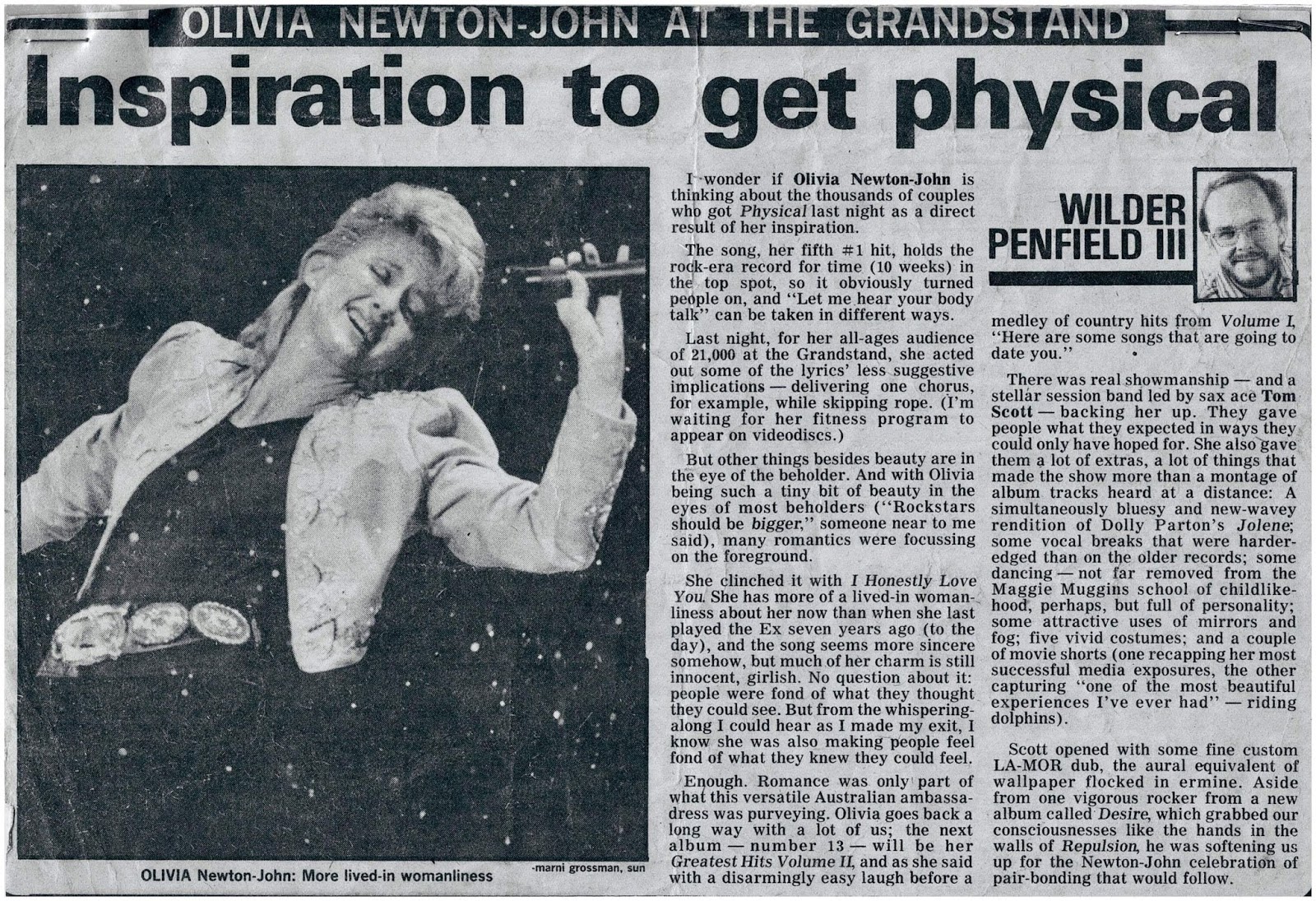
Although a concert tour wasn't something she had planned to do at that time, or was even keen to do, when the Physical album exceeded 10 million sales, and the single placed her at number one in Billboard's single chart for ten weeks, and became the equal second longest chart-topper in US pop history behind Elvis Presley’s Hound Dog, she knew it was time to hit the road, for what would turn out to be the biggest and most successful tour of her career. Most of the dates across North America were staged in large stadiums and arenas and were pretty much sold out, but the one that attracted the largest audience, and had fans going mad for tickets was at the open air CNE Grandstand in Toronto on the 26 August 1982. For author Darlene L'Archeveque, then a 17 year old fan who had travelled on a Greyhound bus for three solid days from one side of Canada to the other, it was, she wrote in her award-winning book, A World of Good, one of the most magical moments of her life! Having been a fan since she first heard Have You Never Been Mellow seven years before, she couldn't believe she was now in the same place at the same time as Olivia.
 

"There were thousands and thousands of people just like me there waiting to see Olivia. We were all there for the same reason. Suddenly, loud crisp music began to play and the crowd burst into cheers. Flashes from the camera bulbs played with my vision. A giant video screen played a retrospective of Olivia's career from her Country days, to Grease and Totally Hot, to Xanadu, Cliff Richard, and then, Physical. The response from the crowd was deafening. Just when l thought it couldn't get any louder, from out of nowhere, Olivia appeared! I clapped along but I was as so captivated by the sight of her that I preferred to stand and take it all in. The atmosphere was spectacular. Even from a distance Olivia looked absolutely radiant."


Equally  excited was Brad Gelfond, then a young agent, who was involved in the booking of the tour, and spent a lot of his time on the road with the tour. "There was something really thrillingly excellent about being in the arena when the lights go down, and the fans start screaming for the artist. When the artist arrives on stage, it’s the greatest moment. I learned a lot about representing big, popular clients through working with Olivia. The coolest thing for me was that they were traveling by private jet. That meant that they would be based in a centrally located spot, like Atlanta, Nashville or Dallas, for a week or so, and on the afternoons of the shows, the touring party would hop in limousines to the airport. The plane would take off when we got there, and we would fly for about an hour to the next city, get limousines there, and then go to the backstage area of the arena. After the show, before the lights were even on in the arena, we would be in the limos on our way to the airport, then flying back to the city we were based in." Not that was always the case. In Toronto for instant, Olivia stayed overnight, in her tour bus, which also doubled up as a dressing room in certain cities that the tour visited.

With the success of the Physical TV special and video release the previous year, and the album now being in the Top Ten albums of the decade, it was no surprise that she became obligated to providing footage for a TV Special and video release of the tour. That footage was filmed during two shows at the Weber State University in Ogden at Utah on the 12th and 13th October, which to many seemed an odd choice as it was the very same city where two radio stations had banned Physical for its suggestive lyrics, but perhaps that was intended as a statement of just how popular Olivia and her #1 song had become. The final edit for the TV special and subsequent video release of the concert, with added special effects and several songs and video interludes cut from her 90 minute set, was first shown on BBC1 in the the UK as a 60 minute special on 21 December 1982, one week before Grease had it's first UK TV airing on the same channel. In the States, HBO premiered the 90 minute version on 23 January 1983, as Olivia: Live in Concert, and later released on both VHS and Laserdisc by MCA Home Video. As expected the TV special was quickly snapped up for worldwide distribution and ended up being shown on most television networks across the world, as well as being released on VHS video in most international territories. The project was another roaring success the world over, winning awards and accolades and added yet another dimension to what had now become the most successful period in Olivia's career. In Britain it was supported with the release of a new 20 track Greatest Hits compilation and a single featuring a remixed I Honestly Love You and an extended live version of Physical.

Olivia with her 1982 tour crew, rig truck and bus. Photo by Michael Landau

Since the album had been released I had collected a stack of promo material from EMI, for my own private collection, as well as providing me with all the necessary material to create some visuals for my art portfolio to illustrate my graphic design abilities in my attempts to get bigger and better artwork gigs! I produced a tour book cover, an EMI Records ad and a backstage pass, simply to have her in my portfolio! Unbeknown to me at the time, they would provide me with enough material to show Arthur what I was capable of as a graphic designer. But that was before I had seen the tour book that Arthur showed me in his office and told me to take home to take a closer look at it to give me some ideas. When l looked at it, it completely blew me away, simply because it was so arty, creative and imaginative, and was something I felt I couldn't have bettered or even equaled! To me, it was light years away from the kind of tour book I had been doing at that time, which was simple tour book design for the likes of such artists as Frankie Laine, Rita Coolidge and Glen Campbell. Olivia's tour book was what I called the top end of the pop market, the kind that bands like Bananarama were producing.

Back in those days, of drawing board graphics, and being pretty much a newbie in that field, I was still some years away from doing tours for the likes of Elkie Brooks, Chris Rea and Elaine Paige! I think that is when I realised I couldn't better it, and had Olivia toured the UK, as was being planned at that time, Roger Davies Management would have simply done the customary thing and sent the U.S artwork to the British promoter for the appointed merchandiser to change things like the itinerary, tour credits, discography, update the programme notes to reflect her career in the UK, and change the album page from her MCA catalogue to her British EMI releases, so I realised pretty quickly that all I could hope to get out of it was maybe artworking some of those changes, and perhaps designing a poster, newspaper ads, and backstage passes! Back then, before I was a writer, I was chasing several ideas for my Artsleeves design studio, all of which included designing for Elvis, Blondie and Dr Hook, and along with Olivia, I did in fact have mock up visuals for all those artists in my portfolio! What haunted me in early 1983 was the fact that this was likely to be the last time Olivia would tour for some years, so it was the perfect opportunity and my best chance yet of getting my foot in the door, so to speak, despite the fact that it was at that time, out of my graphic design expertise. Having Olivia in my portfolio was a perfect artist to have among my mock ups to show tour promoters, merchandisers and record companies, but like with my ideas for the Elvis, Dr Hook and Blondie album covers, nothing came out of it! Call it timing, inexperience or just unfortunate, but I was chasing something I wasn't quite ready for.

When Physical came out in 1981, the album not only transformed her but also her fans, of which I was one, and had been since seeing her live at the Brighton Dome in 1971. It was like we had all suddenly been given permission to get physical from an artist who was thought of as a miss goody-two-shoes but actually wasn't. By her own admittance she regarded herself too old to be innocent. It was like she was duplicating her own coming of age and was telling a generation of musical virgins to lose their virginity to her album! The impact that the album, the tour, the TV specials and videograms made on me and a whole generation of Olivia and music fans was truly amazing to witness. You couldn't walk into a store in 1981 and not hear the album being played over the loudspeaker system, or see the VHS showing on TV screens that some shops had set up in their stores! Olivia and Physical was everywhere! She was the hottest name in music! More so than she had been in her entire career. And I wanted to be part of it, but sadly for me, there was nothing to be part of!

Olivia during tour rehearsals with Dennis Tuffano

Four years later, I got a taste of what meeting Olivia could have been like, when I designed the tour book for the 1987 Elaine Paige UK tour, and had to take the artboards for Elaine to approve where she was rehearsing at the Nomis Studios in London. After we had been through the artwork page by page, I was invited to stay and watch her run through her show with just her basic band! To be in a tiny studio and observe Elaine sing live, just yards in front of me, was in the words of Olivia's 1980 hit, magic! Although I had listened to Elaine many times on record, nothing prepared me for how powerful her voice would be in person in such an intimate setting. Simply put, it was out of this world and to use an overused cliche, literally blew me away! I imagine that is exactly how I would have felt had I watched Olivia run through the set list for her Physical tour if she had brought it to the UK and had I got the gig!

With thanks to Darlene L'Archeveque for the scans from her private collection of the Toronto Star cutting, Michael Landau's tour crew photo and her after show guest sticker, and to Sabrine Korsel for allowing me to use the rehearsal shot she posted on the Official Olivia Facebook group, and to Bri Leic for the audience recording of Olivia's concert in Oakland on 10 October 1982.

Sunday, 21 October 2018

The Cliff Richard Diamond Liner Notes

Last Monday, the Cliff Richard Fan Club's charity CD single was released, one day after Cliff's 78th birthday and he had been presented with a copy by the fan club, during a soundcheck at the Royal Albert Hall in London. The strictly limited CD edition of the single had been available on pre-order since 24 September from Leo's Den, but had sold out in less than a week. For those unlucky enough not to have got a copy, here are the liner notes that I wrote for the CD version, but not available with the MP3 download that is currently available on Amazon...
The story of how this very unique CD single came about started long before it was decided to green light the project and turn it from an almost impossible dream into a reality. It really started with an email in November 2017 which Carol Hall, the president of the London and Surrey Cliff Richard Fan Club received from Susanne Fritsch, one of the club members, asking if there were any plans to present a gift for Cliff from his fans to celebrate his 78th birthday on 14 October 2018, and to mark his 60 years in show business. Carol decided to raise Susanne’s suggestion with the club’s Facebook page members and run a poll to establish if the members would be interested in donating to such an idea. It soon became apparent that they were! Everyone it seemed loved the idea of a Birthday and anniversary song, but the reality of making it happen was the part that needed careful planning and execution. If this could be pulled off, then it would be a fan club first that no other artist fan club had even got close to! Far more important than that was the sentiment of the project. To have a professionally written and produced song inspired by lyrics and sentiments donated by fans, which would be an extraordinary and unprecedented personal gift to Cliff. The big question was how to go about it and make it happen?
By her own admission Carol knew nothing about the record industry or even how one would go about producing a song, let alone getting it recorded. After commandeering the help of industry veteran Steve Carroll, it became clear that the fund would have to cover the cost of recording, studio time, mixing, mastering, artwork, packaging, manufacturing costs, digital distribution, producer, vocalist, musicians, and a load of other incidentals that Carol probably hadn’t even thought of. In other words, a ton of money. Initial enquiries came up with a ball park figure of around £4.5k to realise Susanne’s idea for a song for Cliff, but what an achievement it would be! What better way to thank Cliff for all the years of enjoyment he had given his fans than through a specially written song in which every fan had the opportunity to express their love and dedication! Carol launched a fund raising campaign on Facebook and through her club magazine, but little could she or Steve have imagined how fast and furiously the money would start flowing in to what was now called “The Diamond Song Project”.
The idea was to raise the budget needed for a song to be professionally written, recorded and produced, made available to download as an MP3 to be released on 15th October, and to produce the limited edition CD you now hold in your hands. This in turn would give the project the added bonus of giving proceeds from its sale to one of Cliff’s favourite charities, Tearfund, who are celebrating their 50th anniversary during this same year as Cliff was celebrating his 60th. Cliff had announced a new concert tour, and that could just provide the ideal opportunity to present the fan club’s gift to him, either on or off stage, on his birthday at the RAH in London, but by no means was this guaranteed. The presentation to Cliff would include a copy of the CD, plus a specially framed ‘scroll of honour’, which would include the name of everyone who had donated and contributed to the project. In addition to offering fans the chance to donate to the project, it also offered them the chance to submit up to two lines of lyrics that might have been incorporated into the finished song. Another Facebook poll meant that they could also vote on whether the song should be an up-tempo number or ballad. They decided it should be a ballad. When you think of the project in those terms and just how complex it was, and what was involved in making it happen, it was, without question, one of the most ambitious ever launched by a fan club of any artist. Many would regard it impossible, a farfetched dream, and above all, simply not feasible. 43 days after the idea was put to fans though, enough money had been raised to make it happen, so now the real work began to turn the dream into a reality.
From January onwards, Carol kept raising money through the fan club Facebook page, and started to collate the lyrics that fans were sending in with their donations. By the end of February, Carol had contacted the UK Songwriters Guild and eventually found Paul Whitfield who agreed to write the song, both music and words, based on the lyrics Carol had collected from fans. Paul produced a demo two months later in April. During this same period Carol was thinking over who should sing the song, and agreed with her partner-in-crime, Steve Carroll, that it should be a female. She got in touch with Suzie Furlonger and Helen Hobson who were both honorary members of the fan club. Suzie and her husband were expecting their first child so declined the offer, but Helen, was delighted to become involved, offering her professional services for free. It had been some years since she had seen Cliff and had played Cathy to his highly acclaimed portrayal of Heathcliff from 1996 to 1997, and so, the idea of being able to sing a song dedicated to someone she admired, loved and had worked with, simply delighted and thrilled her. Carol, of course, was equally thrilled to have found her voice.
Steve was busy pursuing more donations for the project, including a sponsor for the presentation frame. Both Carol and Steve were busy trying to improve every aspect of the project. Then in early June, another unbelievable surprise happened, when Carol received a message from none other than Alan Tarney who after being told about the project had expressed an interest and was keen to come on board to produce the track, also agreeing to offer his professional services for free as it was a charity single. It was Carol’s icing on the cake, the answer to her dreams to find someone to produce the song. She was completely, as she put it, “beyond excited!” Alan, probably best known for his production of Cliff’s ‘Wired For Sound’ and ‘Always Guaranteed’ Top 5 albums was the perfect choice to undertake producing duties. On the 17th June, Helen laid down her vocals at Alan’s studio, with Alan at the helm and John Brant engineering the sound. The competed track was sent a few days later to Cliff’s regular sound engineer, Keith Bessey, who Alan had in mind from the start for mixing and mastering the track ready for MP3 download and CD production. Once again Carol was literally blown away that she had managed to secure three major players for her project that at one time or another, had and still do, play a role in Cliff’s own recording career. What a literally astounding result for a project that had started out as just an idea. It was now happening for real and with three people she could have only hoped for. When she broke the news on Facebook, the fans were equally ecstatic, and who wouldn’t be? There was even more exciting news around the corner for her to share with the fans. The project has come in under the budget thanks to so many for giving their time and expertise for free. Carol had collected - at the time of writing this - a staggering £8.5k which meant the club’s donation to Tearfund far exceeded what she hoped for, that anybody could hope for. When she broke that news to Tearfund, they too were very excited. No one had raised money for them in this way. A very unique CD project!
When Keith Bessey sent Carol the finished, fully mixed and mastered song, she was suddenly and quite unexpectedly hit by the enormity and emotion of everything she and the fans had achieved. You’ve bought this song, and you have contributed to it. It is, as the cover suggests, the perfect gift to Cliff from his fans to thank him for all the fabulous years of pleasure he has given us through music, movies, TV performances and concerts. This song... a specially written, produced and beautifully crafted song, really says it all.
From us to you!
Thank you Cliff, Happy Birthday and huge congratulations on your 60th anniversary!
 

Wednesday, 3 October 2018

The Oh Boy! Album - 60 Years On!


Although many people think Cliff Richard's first album was the live set he recorded, backed by the Drifters, at Abbey Road Studio 2 in front of an invited audience of 200 fans in February 1959, simply titled Cliff, and released two months later, his first appearance on LP, was in fact on Jack Good's Oh Boy! soundtrack album of the hit TV show that was released on EMI's Parlophone label in October 1958, six months before his own debut album appeared the following year, so not only is Cliff celebrating the 60th anniversary of his first single, Move It, this year, but also his first appearance on an LP, that he shared with other artists from the show. What is remarkably interesting though, is that Cliff had more tracks on the album than any of the other artists featured. But perhaps that shouldn't be surprising when you consider this was the show that launched Cliff as "the boy who was going to rock the world!" Out of the twenty four selections, seven were by Cliff, while the rest of the album was made up by numbers from the other show regulars such as the John Barry Seven, the Dallas Boys, Vince Eager,  Peter Elliot, Cuddly Dudley, Neville Taylor and the Cutters, and the Vernon Girls.

When I was working on upgrading Cliff's catalogue for EMI with Peter Lewry, this was one of the albums we suggested should be put out as a special edition with bonus tracks, but sadly there were licensing issues due to getting clearances on the tracks by the other featured artists, despite the fact they had reissued the album a couple of times before, in the late seventies, through their own budget and mid price MFP (Music For Pleasure) label. Although we were unsuccessful in persuading them to re-release the original album, or produce a special edition, we did manage to include all the tracks that Cliff had recorded for the album on Disc 4 of the Rock 'n' Roll Years box set in 1997. What many may not realise is that Cliff was not at the recording session in Abbey Road's Studio 2 along with everyone else on the evening that the album was recorded as he was playing Colston Hall in Bristol as one of the support acts on the Kalin Twins package tour, so he went into Studio 2 to record his seven tracks for the LP two nights later, all of which he had performed in various episodes of the TV show, and like the rest of  the album were taped without an audience, even though it was marketed as if there was.

To celebrate this milestone, below are Jack Good's original album liner notes...

This recording was made in one session on the evening of October 19, 1958, the day before ABC Television had transmitted the sixth edition of 'Oh Boy!' and already the show was a smash hit. The number of viewers had doubled. Stage shows and films were being mooted. And now the L.P. In six short weeks 'Oh Boy!' had grown to the stature that '6.5 Special' had taken nine months to achieve. For, by an odd coincidence, October 19, 1958 marked to a day the first anniversary of the session at which the '6.5 Special' LP was made. And at that time '6.5 Special' had been running nine months. Both discs were made by Norman Newell and at both sessions I held a watching brief as producer of the television programme concerned. The difference of these two occasions formed a clear reflection of the changes that have taken place in the world of popular music.

A year ago we were at the height of the coffee bar era. The music was frantic, erratic and, for the most part, it had an intimate and amateur flavour. Nowadays the whole thing has become much more streamlined and professional. The music is no longer improvised to the large extent that it was. All the "Oh Boy" numbers are carefully and brilliantly arranged by our MD, Harry Robinson. Melody is now playing a much more important role - though the beat is just as insistent and exciting. Singers are currently set a much higher standard than in the early rock days. They are expected to count bars and sing in key, two things formerly regarded as frivolous refinements.

Summing all this up, the '6.5 Special' LP session had the excitement and hubbub of a jumble sale; the "Oh Boy" session had the excitement and organisation of a rocket launching. All the artists and all the numbers on this record have been featured pm the actual show and, just as in the programme, we race from one item to another without pause. It was a very happy recording session. The audience has a whale of a time (as you can hear) - so did the artists. But then they always do. It is such a friendly team that every rehearsal and transmission is like a party. That this atmosphere has been vividly captured by the L.P. is a tribute not only to the skill of those at E.M.I. who created it, but also to the imagination, faith - and, dare I say, courage? - of A.B.C Television who gave the "Oh Boy" show a chance to prove itself on the millions of television screens it serves.

Sunday, 2 September 2018

Winona Ryder - The Biography Revisited

In this first part of this special two-part blog article, I am thrilled to offer some background information on the making of my Winona Ryder biography that was published in the UK twenty years ago today in paperback by John Blake Publishing ... 


My love of movies dates back to the early 1960s when I first went to the cinema, with my parents, to see Carry On Constable, or at least that is my recollection of the first time I was treated to a night out at the pictures, but then twenty-six years later something extraordinary happened, I went to see a movie called Lucas. As I watched the scenes that featured a total unknown named Winona Ryder, I was moved by the vulnerability behind her huge hypnotic brown eyes. She has captivated me ever since with her public profile and each of the movies she has appeared in from the age of twelve. When I discovered in 1996, some ten years and almost twenty films later, that there had never been a biography about her, I felt compelled to write one, which then consumed the next two years of my life, and with running a Facebook fan page for the book, still does to this day. 

Twenty years on from when it was published, I thought it would be interesting to reflect on what became a major turning point in my writing career as up to that point I had only written music reference books, with the exception of a lightly worded illustrated biography of the Rolling Stones first ten years, but now I was jumping in at the deep end to write a full length biography of my favourite actress. I also want to try and address some of the questions I am often asked about the book. Several questions persist. How and when did I get the idea to write the book, did I ask Winona to participate, how did I go about the research, who did I speak to, and when will I update the original book?

Strangely enough, I was hoping to publish a special 20th anniversary edition this month, but could not find a publishing home for it. The idea for the all new edition was to completely revise the existing book by doing a new volume which would have been divided into three parts. The first part would focus on revisions to the original manuscript that have come to light since the book was first published, the second part would have been the original biography as it was published in 1998, and the third part  was to go from where the original book left off up to the present, Stranger Things, and her latest movie Destination Wedding. But every publisher that I approached with it didn't feel that now was the right time to be republishing, even with all the additional content and Winona's renewed profile. My feeling was and still is that there is no better time to re-access her life and career. As I told the editorial and sales teams, as an actress who changed the way cinema depicts women, and has championed for so many in the industry, she deserves a really good and up-to-date biography to be available, but sadly it was not to be. The new edition would have created a completely new portrait, which among other things would have told the exclusive untold story of her first and fascinating experience with the still camera some years before she was cast in her first movie, including my author interviews with photographer and stylist, take a fresh look at her early years from her first kiss on a playground carousel to her love of skateboarding and returning to the limelight in the medium she once swore she would never do, and to question why she still refuses to conform to the Hollywood ideal of fame.      

So how did the book all come about in the first place? Well, the initial idea came from Hannah MacDonald, then the publishing editor at Virgin Publishing. I had called her to ask if she would be interested in commissioning me to write a biography of Olivia Newton-John. Hannah's reply was not really. She said she was looking for someone more current at that time, someone who was regarded as young, cool and hip, someone like Winona Ryder. What Hannah didn't know that just a few weeks before that call in June 1996, I had gone to see Winona's then latest film How To Make An American Quilt at the MGM multiplex in Eastbourne with my daughter Kim on National Cinema Day that was celebrating 100 years of cinema, when 742 cinemas across the UK showed selected films all day long and charged only one pound to see any film. There were over 150 films to chose from. As well as the current releases there were 27 previewing films and classics ranging from Casablanca to the Sound of Music, and one of the previewing films was Winona's movie. When we left the cinema I said to Kim, "It's no good, I have to write a book about her!" So can you imagine how excited I was when Hannah told me that Winona was the kind of biography subject they wanted to publish, and not ONJ. I was secretly thrilled and spent the rest of the call trying to persuade Hannah that I was the right person to write a book about Winona. I prepared a proposal, sent it to Hannah, which she presented at a number of publication meetings, but it was rejected, which although disappointing, still encouraged me to start touting it around other publishers.

Most rejected it in their belief that Winona, although ranked among the top ten box-office stars, and certainly one who encourages millions of fans, still didn’t have the profile to warrant a book. I remember one publisher telling me that most bestselling film biographies were the ones about the male heartthrobs, or if female, the ones with a reputed gay fan following, and as Winona didn’t fall into either category, I didn’t find anyone rushing to do my book. The only publisher that showed any real interest was Robert Smith who owned Smith Gryphon Publishing, and had been producing a steady flow of celebrity and true-crime bestsellers since 1990. Although he could see how passionate I was about Winona as a biography subject, and had liked the attention of detail in my Stones book, he was still unsure about commissioning me unless the book was authorised, and I already knew that wasn't going to happen. Like Robert, I was only too aware, how difficult it is to encourage someone like Winona to participate and contribute to a book project, and even though Robert shared my view that it is better for a celebrity to co-operate and/or authorise a biography to ensure accuracy, not many Hollywood stars and their publicists shared that view. Nevertheless I had a go. In fact, I approached Winona’s publicist several times with several ideas asking for Winona’s co-operation and an interview, but as I have explained in my author note, her publicist made it clear that they were uncomfortable with the idea of a biography at that stage. When Hannah moved from Virgin to Andre Deutsch, she came up with the idea of Winona writing her own film dairies for a year or so, with me editing, but even that was a no-no.

Out of all the publishers I approached, Robert was the most interested, and despite turning it down to start with unless I could get Winona involved, he did eventually come back to me about eight months later, when I was about to put the book on the back burner, with an offer for an unauthorised work, and gave me a weekend to consider his offer because if I was going to accept, he needed know two days later so he could include the book as one of the lead titles in his Autumn 1997 catalogue, which had to go to print the following week, so after chewing things over, and accepting his terms and conditions, I began writing in the early part of that April, and quickly got up to speed as the manuscript had to be delivered at the end of June for publication that October to coincide with the landmark release of Winona’s twentieth film, Alien Resurrection. But about two weeks before it was due to go to print, Robert told me that he was having to dissolve his Smith-Gryphon publishing operation. The company and his entire catalogue of books would be offered for sale to other publishing houses, so my book, then titled Winona Ryder: The Unauthorized Biography, became stagnant, and was seemingly caught in the middle of a liquidation trap.  

After several offers were made to Robert's receivers, Smith Gryphon was eventually sold to Blake Publishing, who acquired the entire SG catalogue, but I still had no idea at that stage if they would publish my book or not, but as it turned out, once they had managed to rescue the book from Robert's printers, they scheduled a publication date for April 1998. The icing on the cake was the plan to publish it in hardback, now with two picture sections, rather than one, and with a new cover design. But their attempts to rush out my book didn’t really work out. WH Smith, then the biggest and most powerful bookseller in the UK were reluctant to order a hardback, and they also felt that they had not been given sufficient notice of publication, which was rather strange since Virgin’s sales teams had already been out selling the title for Smith Gryphon. Reluctantly Blake put publication back to September, and also decided to produce the book as a large format trade paperback instead of a hardback, simply because that's what WH Smith wanted and as they would be ordering more books than any other bookselling chain, Blake went along with their demands and decided to publish as a paperback edition only. The only differences would be the price and would now be in soft covers rather than a hardback. Even though I'd had my heart set on a hardback edition for April, there were advantages. with the delay and different format. I now had the opportunity to ensure that my book on Winona would be the most up-to-date published, which I think it was at that time since it ended with the story of Winona dating Matt Damon. Something that surprised Entertainment Weekly when they had been sent a proof copy for review and interviewed me for their magazine. They seemed genuinely amazed it was so up to date. The delay had allowed me to do that. It also give me the opportunity to do some fine tuning and polishing to other parts the manuscript. Not so good however was how we had to change the picture spreads due to some permission issues.

Most of the film companies were reluctant to grant permissions for some of the movie stills because the book was unauthorised, which was understandable. Although we could have licensed the stills from a number of picture agencies, my picture editor thought it was best not to since the film companies had objected to their use. I do remember calling Fox in the States to ask if we could use a publicity still from Alien Resurrection, whose response was yes as long as I got permission from Sigourney Weaver, Winona and the photographer, none of whom I had phone numbers for, and as Fox weren't about to share them with me, we didn't pursue it any further as it seemed out of our reach and a bit of a prohibitive exercise. With or without the Alien Resurrection shot, we lost a lot of images that we wanted to use. Mainly stills from Mermaids, Edward Scissorhands, The Age of Innocence, The House of the Spirits, Reality Bites, Little Women and The Crucible. It was very disappointing, but we managed to replace them with some relevant pictures, something that still had a connection wherever possible. For instance, we used Winona receiving her Golden Globe for The Age of Innocence, and Winona and Daniel Day-Lewis at The Crucible premiere in place of the actual movie stills.

In fact, I think we ended up with a selection of pictures that at that time hadn't been seen before, but then again it was in the pre-social media days and when the internet was still in its infancy, so yes, they were pretty rare for their day. Back then, I thought it made the plate section for the book far more interesting, personal and relative to the text. We actually ended up with some rather good shots. The most amazing find came from the Petaluma Argus-Courier who had shot Winona's very first publicity photo in her classroom at Petaluma Junior High in 1986. It's quite remarkable to look back on now because I don't remember there were any permission issues for the pictures in the Smith Gryphon version. Most of the photos had come from my private collection, and included some very iconic images of Winona, but I don't remember ever being questioned about ownership, but back in those days I was still a bit of a novice when it came to such things, and perhaps Robert wasn't too bothered about it either, or maybe, he thought I owned the photos or had clearance on them to use. 

In the next part of this article, I revisit how I went about the research for the book, who I managed to speak to and interview, including a scheduled but cancelled phone interview with Winona, and look at the aftermath of the publication and how the book came a Daily Telegraph bestseller and got nominated for a literary prize!

The cover for the Smith Gryphon version of my book 

Tuesday, 23 May 2017

Olivia Newton-John In My Own Words


What a truly pleasant surprise it was to hear Olivia Newton-John telling her own story in her own words on BBC Radio 2 over the last couple of weeks. I say surprise because Olivia  is not someone who is known for talking about her own life and career, has never written her own autobiography or participated in any book about herself, and there was a time when l wanted to do one, and is generally not someone who is known to give a lot of interviews or talk openly about her life of career, although since this blog was first published, Olivia has written and published her own memoir, Don't Stop Believin'.

Not only did I want to write a book about her, with her co-operation, but with my Cliff Richard writing cohort, Peter Lewry, we made several attempts to interview her about the duets she had recorded with Cliff over the years for our book on Cliff's recording sessions. To this day, it is still a bit of a mystery why she didn't speak with us, but maybe it was down to the fact that she may have felt a little uncomfortable to talk to a couple of unknown wannabe rock writers putting together their first book on one of her favourite people, despite the book being approved and authorised by Cliff himself, unless of course she never received our request that was sent to her through Cliff's office, which can often happen and does. It is not unknown for interview requests never to reach the people they are intended for.

We made other attempts to interview her, but again, without success, about some of the recordings we re-released on the Cliff album remaster series for EMI, including the backing vocals she contributed to the Cliff Live in Japan 1972 album, so with all that in mind, it was nice to hear her talk about recording Don't Move Away, her first B-side duet with Cliff in 1970, on the Radio 2 programme, as we had very little information about the recording apart from what Cliff told us, and what we found on tape boxes and recording sheets at Abbey Road. What I did find interesting to hear her say was how petrified she was about going into the studio with such a big star as Cliff and having to record with an orchestra, neither of which, she had ever done before. For the purists, the track was recorded at the same session as the two other songs that appeared on Cliff's Sunny Honey Girl maxi-single. And even though Don’t Move Away was the first track to be completed with the third and last take being used to make up the final master, it wasn't remastered until we added it as a bonus track to the the reissued Tracks ‘n’ Grooves album in 2004.

EMI Abbey Road tape box for Don't Move Away session

It was a great shame we didn't get to speak with her as we found quite a few alternate takes, some with Cliff, and some of her own recordings for singles and albums, and even though we wouldn't have included any info about her early work with Bruce Welch and John Farrar in a book about Cliff's sessions, it would have satisfied my curiosity to have had the opportunity to listen to them, discover their history, and find out why certain takes were chosen over others, and why some remained unreleased, but sadly it was not to be. 

What is strange is that she didn't mention the backing vocals she did on the Shadows version of Cliff's The Day I Met Marie on the EMI 1967 From Hank, Bruce, Brian and John album on which she provides an ethereal rendition of “baby, go to sleep now” on the chorus. Neither did she mention her playing recorder as an accompaniment on Music Makes My Day on the 1973 Hank Marvin and John Farrar album, which was also released as a single that same year! If any readers don't have the original vinyls, both tracks can be heard on Spotify.


Probably one of the most interesting things we uncovered about her recording work with Cliff was the recording of Suddenly. For those who have read our book, you will know that Olivia's vocal for the duet was recorded in a garage located in Los Angeles, which obviously created some acoustic problems with traffic noise levels outside. Compounding the technical problems was the recording method used of Cliff and Olivia taping their vocals simultaneously onto a pre-recorded backing track. We were told that Olivia returned at a later date to re-record her vocals due to her track containing the noise levels mentioned. We were unable to trace the origins of the backing track or the musicians featured and never found any tape boxes or recording paperwork, and although it would have been something we would have asked Olivia, as we did Cliff, like Cliff, she may not have remembered.     

As Cliff said in the first episode, everybody loved her when she first burst onto the scene 50 years ago, and I was one of them. For me it started back in 1971 when I bought her first album, simply titled Olivia Newton-John, and went to see her live in concert at the Brighton Dome in November the following year, for which she wasn't top of the bill, but shared supporting act duties with Labi Siffre to headliners Cliff and Marvin, Welch & Farrar. Her set included If Not For You, Angel of the Morning, If, Everything I Own, What Is Life, and her then latest single, Banks of the Ohio, the third single to be released from her first album.
 
Double page spread from souvenir brochure featuring full size promo shot and record ad

Thursday, 17 November 2016

Cliff At Christmas

Over the years, I have often been asked about Cliff's 2003 Christmas album, how did it come about, whose idea was it, and why no liner notes? Below, is the press release that I wrote for EMI to help promote the album, which hopefully will answer some of those questions, and for those who missed having a liner note, hopefully this be a good alternative...


When Mistletoe and Wine went to number one and became the best selling British single of 1988, it also became representative of one of Cliff’s most successful genres: the Christmas song. Like gospel music, it is a body of material that speaks directly to Cliff’s roots, and one he enjoys celebrating. With both new and old recordings, CLIFF AT CHRISTMAS brings together – for the first time – a collection of Christmas favourites.

Due in part to the success of the single Millennium Prayer, and in part to the almost traditional association of Cliff with Christmas, even when he had Christmas hits that weren’t Christmas songs, Cliff has decided, this year, to create an album of purely Christmas repertoire. The idea was to cut eight new songs and put them on an album with some familiar favourites. Although four of the ‘older’ tracks would be remixed to bring them into keeping with the new recordings, there is the handful that appear in their original form, all digitally remastered, to remind us of the unprecedented run of Christmas hits that Cliff’s had ever since his version of O Little Town of Bethlehem was released in 1982. After all, no Christmas album by Cliff could be considered complete without the Christmas number ones like Mistletoe And WineSaviour’s Day and Millennium Prayer.

Nor could a Christmas album by Cliff be considered complete without his own stylish arrangements of seasonal standards like Silent Night, which interestingly enough, includes his own additional lyric of Mistletoe And Wine ‘just being played on the radio’ – but now with a new hidden extra.

Another is White Christmas, the Irving Berlin favourite that Bing Crosby recorded in 1942 for the film Holiday Inn, and has since been in the charts every year at Christmas from its first release all the way through to 1962. Though dozens of artists have recorded it over the years, Cliff has given his own originality to the song. As with the other traditional selections on the album such as Winter Wonderland, When A Child Is Born and Have Yourself A Merry Little Christmas, Cliff says, ‘if you’re going to do a cover version, it should be distinct from the original. So you bend or change the melody, the arrangement, and all the guitar riffs. There’s no need to do it the same way. In everybody’s mind, the original way is always going to be the definitive version. There’s no point in making it sound exactly the same as the original.’

From the list of new material, Let It Snow and Walking in The Air, recorded in Nashville, are probably among Cliff’s favourites. ‘I did those tracks with Michael Omartian and I loved working with him. He was fantastic. They were really done as test cases to see how we would gel together, and it worked really well. The piano on those two sound great.’

One listen to this 17-track album, which also includes a duet with European star Helmut Lotti, should forever put to rest the question of Cliff’s deep-rooted feeling for Christmas songs and for the traditional simplicity that they represent.

With Cliff’s proven instinct to spot potential hit material, and Christmas number one songs, a special radio edit of Santa’s List, co-written by Chris Eaton, who also penned Saviour’s Day, will be released on 8 December as the single Cliff has chosen to promote the album, and more importantly, to echo his own distinctive feeling for Christmas.

Saturday, 11 June 2016

Me, Elvis and The Sun Collection


Before I was a writer and got published, one of my dreams was to write a sleeve note for an Elvis Presley album, and in the early part of 1975, I thought I was pretty close to fulfilling that dream. The album in question was The Elvis Presley Sun Collection, which was going to be released that summer and would collect together all of the recordings Elvis cut at Sam Phillips' famous Sun Studio in Memphis between 1954 and 1955 and place them on a 16 track album, that would also launch the then new RCA mid-price Starcall label. It would also mark the first time that all the Sun sides had appeared together on a single album. Previously the tracks, with the exception of I Love You Because (2nd version), had been spread over a couple of earlier compilations in 1959 on A Date With Elvis and For LP Fans Only, while Elvis did his national service in the U.S Army, and were then new to LP.

What is perhaps surprising, or maybe it wasn't when you consider the wealth of its material, is that the album was Elvis's most successful album of that year in the UK. It was released one month after his then latest studio album Today and fared much better in the British album chart, and for the first time in four years, was packaged without the usual live picture of Elvis in a white jumpsuit, but in a sleeve with a striking illustration that reflected the music inside, and was, in fact, based upon a photo that had been taken during Elvis's historic performance at the Cotton Bowl Stadium in Dallas on 11 October 1956.

I can't remember where or when I first heard about the project, but if my memory serves me correctly, it was probably through the pages of the New Musical Express as the project was the brainchild of NME writer Roy Carr, who had collected all the tracks together and had somehow persuaded RCA Records in the UK to release them. Neither do I remember if the project had to be approved by Colonel Tom Parker before it got green-lighted for release, but let's presume it was, and they usually were, isn't it strange that Elvis seemed genuinely surprised and amazed about the album's existence when a British fan handed him a copy during his Dinner Show performance at the Hilton Hotel in Las Vegas on 13 December 1975, and despite what some have assumed on various Elvis internet forums that I was that British fan who handed Elvis the album, I wasn't.

Back in Britain, before any of that, my first port of call was to Shaun Greenfield, then the RCA product manager in the UK, who looked after all of Elvis's UK originated albums, and as this was a UK only release, Shaun whom I knew and had met previously in London's RCA offices, was my best bet. I asked him about the project, and whether or not he was looking for any sleeve notes for the album. Shaun gave me all the details, and told me that it was Roy Carr's baby, and although it was expected that Roy would write the liners, he told me I was most welcome to submit some of my own. At that stage it was uncertain whether Carr was going to write any notes, but when you consider it was his project, and as he was one of Britain's most respected music journalists, it was pretty obvious to me that he wouldn't want some wannabe rock journo treading on his feet for a project that was obviously close to his heart.

The offer that RCA made me was simple. If Roy wrote the sleeve notes  then they would be used, but if he didn't, and if the notes I was going to write, were good enough, then they would use them on the album. In the end of course, and as we all now know, Roy ended up writing the notes, and they were the ones, along with a detailed discography that appeared on the back sleeve of the album. It was the first time ever that such a lengthy, informative and factual sleeve note had appeared on an Elvis album. At the time I started to write my notes (which weren't anywhere near as detailed or as lengthy as Carr's), it still wasn't certain if and when Roy would supply his, but as luck would have it, by the time I had written mine and sent then to Shaun, Roy had already completed his, which were now in the hands of RCA.


Listen here to a live audio recording of the British fan giving Elvis the album

The only copy of the notes I kept was my own personal copy which I had printed on the back of a blank white 7-inch record sleeve, which I decided in the end to send off to Elvis's father Vernon, while he was in Las Vegas during Elvis's December 1976 season at the Hilton Hotel. I thought this was the best bet to get my work seen by Elvis and acknowledged with his autograph, which in my letter to Vernon I had asked for. The sleeve was returned to me, duly signed "Best Wishes Elvis Presley" from Memphis Tennessee in February 1977, the same month that Elvis's new single Moody Blue was released in the UK. Unfortunately the signed sleeve got lost in a house move during the early 90s, and the only photographic evidence I still have to this day is in a picture cutting that my local newspaper, the Evening Argus, ran in September 1977, when I was the Sussex branch leader for the official fan club, in which I can be seen holding the signed sleeve, a scan of which I have included below.