Wednesday, 26 June 2013

The Elvis In Demand Mystery

 
Back in 1976, in the days when I was a graphic designer, I went up to RCA's Curzon Street offices in London, not far from the famous Playboy Club, to pitch an idea for a five track EP of then unavailable movie songs, including the studio version of Johnny B Goode from Elvis On Tour. I did a full proposal and a full colour sleeve visual with Letraset and a letterbox still of Elvis in Charro, which I had picked up at the fan club convention in Leicester, that same year, where I had seen the Aloha From Hawaii TV special for the first time on a big screen. Seems incredible to think about now, but none of the British television companies had at that time scheduled it for broadcast. There was a whole campaign in Elvis Monthly to persuade the BBC to show it, and I seem to remember that RCA had offered to front half the asking price of £50,000, but it was still not enough to persuade the BBC to buy the special, and so it went unseen until a much edited version was eventually broadcast on BBC in 1978.

I can’t remember exactly the date that I went to RCA, but it was probably in the latter part of 76 as I remember being shown the artwork for the Elvis In Demand album, and getting given a poster for the Presley Gold singles campaign, which was a reissue collection of Elvis’s 16 Number One singles in their original U.S picture bags. The album and poster featured the same illustration of Elvis. It was during this meeting that I first heard about the then planned CBS TV Special which according to what I was told, was not going to be a concert special but a mix of concert footage, Elvis taking viewers for a tour around Graceland, and a gospel recording session.

The product manager Dave Mackay at RCA liked my proposal for the movie EP very much, and said that he wanted to make it happen, but told me he would have to get approval from the Colonel before proceeding any further, and would send it over to the Colonel to get it greenlighted. And that was the last I heard of it! A few weeks later, Dave left RCA and had cleared out his office, so I never did see my visual or proposal again. And no one at RCA could find it or trace a letter being sent to the Colonel's office about it.

Elvis In Demand though, was quite a unique album for its time. Marketed as "the most lovingly compiled album ever", it came about when RCA UK invited British fans of the official fan club to select 16 songs from Elvis's extensive recorded repertoire to represent his studio work, Hollywood film soundtracks and live shows. Most songs picked were an assortment of singles, B-sides, album tracks and some obscure movie songs. The idea was to have on one album, as many songs that were no longer available. When news of the project first appeared in Elvis Monthly, to celebrate the 21st birthday of the fan club, it was suggested that this would be a good opportunity to fill in a few gaps for songs that were not currently available in the UK. The article in the Monthly gave a list of suggested tracks that could be included and if memory serves me right, it was most of these tracks, seven of them in mono, that ended up on the final album. Although looking back on it now, the list of selected tracks may have seemed strange at the time, but there was a sensible logic behind it, and it proved to be a most successful idea. It sold over 100,000 copies, peaked at No. 12 in the UK album chart and earned itself a silver disc award. It was released one month after the album's lead single Suspicion had become a Top Ten hit. Many of the general record buying public seemed to think it was a new recording, and that Elvis had returned to his old 60s style, even though the track had first appeared on Pot Luck, his No.1 studio album from 1962. 

Even more strange is the story that Elvis personally autographed 15 copies of the sleeve in June 1977, with "Best Wishes Elvis Presley", which according to those who have claimed to have seen it, was clearly visible in black ink. If true, that would mean the album sleeves would have probably been among some of the last things Elvis would have signed for fans, but one also has to wonder what he must have thought about being asked to sign a record album with such a "ghostly" looking illustration. The 15 copies he is said to have signed, were then said to have been given away as prizes by the Daily Express, even though no cuttings from the newspaper have yet surfaced to support the story. Some say they remember it well, while others don’t, and most are sceptical about the whole thing. I don’t remember seeing any such competition in the Express, but that’s not to say it didn’t happen. It probably did when you consider that Todd Slaughter, the boss of the British Fan Club, had met Elvis to present him with some British awards, during the filming of the CBS In Concert TV Special in the same month that Elvis is said to have signed the copies of In Demand. Although the Fan Club did a lot of shouting about its contribution to the LP, and rightfully so, there are those sceptics who have suggested the whole signed copies affair was just a marketing ploy between the Fan Club and Express newspapers. It would be an interesting exercise to try and find out if Elvis did actually sign the albums, and if any fans do indeed, have a signed copy of it.
 

Friday, 17 May 2013

The Lost Article

I wrote this article for the 25th anniversary of Winona Ryder’s first film, Lucas, a couple of years ago, for a magazine that never ran with it due to re-scheduling of features at the time, and rather than leave it unseen and unread, thought I would post it here for all to read. The images are the original publicity and casting pictures for the film, taken from my own personal collection.


The stylist for one of Winona’s first photo shoots just over twenty years ago knew that Winona would someday be famous. ‘She was just really focused,’ Abby Minot told me in 2002. ‘She had this vision. You could just tell she was going places.’

And of course, Abby was right. Looking back twenty-five years to the opening of Lucas and to the first time the cinema-going public first cast their eyes on Winona Ryder, most agreed that, even though she would only appear in eight scenes and her role as Rina almost seemed like an afterthought, it was enough to get Winona noticed and confirm the kind of character she would play for the next five years of her career: the alienated teenager.

If there was any doubt, one only had to take a look at the press kit for the movie, which described Winona as ‘fragile with a certain poetic justice.’ And the critics agreed. The New York Daily News credited ‘Winona for turning a small part into a memorable one’, and Variety’s Todd McCarthy remarked that Winona ‘constantly but quietly stole all Kerri Green’s scenes.’ Roger Ebert writing in the Chicago Sun Times said it was easily ‘one of the year’s best films’ and doubted if anyone of any age could give a more sensitive and effective performance.’ In fact, there weren’t many critics that didn’t rave about her performance. According to the general consensus, it was ‘deft, remarkable, and fetching.’ So perhaps it is no wonder that Winona had the critics on her side even before the film was released twenty-five years ago.

Certainly her performance in her first moments on screen would compound the cinema-going public with general critical opinion that Winona Ryder, the girl with the alert expressive eyes that telegraphed a startling combination of intelligence, gravity and self-possession was indeed someone to watch. ‘There is something strangely magical and wistful about her, that is ultimately reflected in her performance,’ said director David Seltzer at the time, and later observed how ‘she was sympathetic playing a child who thought she would never be beautiful.’ It was, he continues ‘very poignant because she was clearly about to blossom into a beautiful young woman herself.’

I am not sure though, that Winona would agree. The first time she watched the film at a screening with the rest of the cast, she says, ‘I was just really scared to see my face that big. It was such a shock that people had just seen me act.’ In the end though, she went to see it another two times. Once in San Francisco when it opened there at the Galaxy Theater, and once in Santa Rosa, where, recalls Winona, ‘a lady sitting in front of me said to the guy she was with that I looked sad on the screen. I guess she meant the part about being hopelessly in love. I wanted to ask her what she meant, but instead I started really looking at myself on the screen. It’s hard to be objective about your own performance.’

Lucas opened on 628 screens in the United States on 28 March 1986 and during its opening weekend had taken $1,250,101 at the box office, ultimately its gross topped eight million and earned itself three Young Artist Award nominations.

Thursday, 4 April 2013

Inspiration


I often get asked who or what was my inspiration to become a writer. And I always say that Winona Ryder was my biggest inspiration. She certainly inspired me to write biography, simply because I was desperate to write about her, which is always the best reason to write. It came about, because I had at that time, watched more of her films than any other actress, and like anyone who had seen her films, I thought she was a brilliant actress. There is something very silent movie about her acting, a quality I really adore. It’s not a style in the sense of a pose or put-on, but something very organic and completely unique to her. I was also fascinated by the fragile energy that follows her through all her films, regardless of genre, so I was really excited to be able to get to write about her, and share my name on a book cover with hers.

I first came up with the idea to write a book about her on National Cinema Day in June 1996, when cinemas across the UK showed selected films all day long, which resulted in over one million people attending cinemas. Organised by the film industry to celebrate a century of cinema, every cinema charged only £1 all day. And there were over 150 films to choose from. As well as the current releases there were 27 previewing films and classics ranging from Casablanca to the Sound of Music and one of the previewing films was Winona's latest, How To Make An American Quilt, so with my daughter, we went to see it, and when we left the cinema, I said: "I have to write a book about her!"    

And once I started, I loved every minute of it. Being able to get up each morning and write about her was the best part about it, I literally couldn’t wait to get started each day. What was strange is how I totally immersed myself in her life, and so when I finally finished it, and delivered the manuscript to the publisher, it was like the ending of a relationship. I do remember feeling quite lost about it and having what I call post-book depression. For me, it is still my favourite book of all the ones I have written, and that was largely down to who Winona Ryder was and me feeling passionate about her and her films, and that is what all writing should be, about following your passion, and for me that was Winona. 

I am also often bombarded with questions like when did I last interview her, what's she like, how was it to interview her, and is she cool? Truth is I have never interviewed her, met with her or even spoken to her, although I have come close three times. The first missed opportunity was when I had just started writing my biography of her and was due to do a telephone interview with her about American Quilt, but then at the last minute, she pulled out from all her scheduled interviews. The second time that I came close, was some years later, in 2004, while I was in West Hollywood and missed Winona at Book Soup by literally five minutes. I had gone up to the store after I had finished filming an interview on Demi Moore for The E! True Hollywood Story, and all the guys at the store knew me, knew who I was, and as soon as I got there, they told me, I had just missed her. She had been in the store five minutes before buying some magazines and books! And the most recent was at last year's London premiere of Tim Burton’s Frankenweenie. Although she was scheduled to attend the premiere at the Odeon Leicester Square, she had to cancel out at the last minute, due to a filming schedule conflict. I was on the red carpet for about an hour waiting for her to arrive, before the film started, and towards the end of that hour, I realised she wasn’t going to show, but if she had, it would have been pretty easy to have spoken with her, but maybe it's not meant to be. They do say, don’t they, that it’s never a good idea to meet our heroes!

Tuesday, 5 March 2013

For Vampire Book Lovers Only

Welcome to my first blog post of 2013!! Can’t believe I have left it so long to write something, so today I am going to do something that I don’t usually do, and that is shout about a book I recently came across by an indie author named Jez Strider who has written and published a series of Vamp Life novels. The first one is the one I am shouting about. It’s called Vampire’s Eve, and I was attracted to download it onto my Kindle when it was on a one day promotion to download for free. The thing that attracted me to it first and foremost was the brilliant cover. I read the synopsis, read the reviews and downloaded it, and am so pleased I did. It is quite different to the usual vampire stories doing the current rounds, and what I particularly liked about it is how Jez takes a modern look into the history of vampires, and even throws in some eroticism that is completely different. Instead of what you would expect, Jez very cleverly conveys emotions without slipping into the erotica category, and yet it remains very erotic.

I decided to catch up with Jez, and ask her about her writing and her book. She told me her love of writing came from her love of reading. ʻMy mom had bought me books at the grocery store for as long as I can remember and my dad was active in taking me to the library. I didn't start writing much until high school when I worked on the newspaper staff. And the first entertainment with vampires I saw was The Lost Boys. I watched it about a million times! After that I read books by Michael Romkey and Anne Rice. And it's just grown from there to me reading all sorts of vampire books and watching vampire movies and television. The lure of eternal life is very appealing, so I decided to write about it.’

In Jez’s own words, Vampire’s Eve is the story of a woman that despite many years as a vampire, thrives among humans. She's been reluctant to open her heart to love, but the right man is changing that. Things are going well until an encounter with her first love turns her world upside down. As if deciding between the two men isn't enough, her sadistic maker is determined to possess her once again.

To wet your appetite, Jez has given me a teaser excerpt to share, which she tells me is one of her favourite moments from the book...

I leaned up to start painting my toenails when my mind finally returned to the present. Before I could begin, a gloved hand covered my mouth. A normal intruder I could have easily bested. There had been more than one time when I’d been cornered in an alleyway. Oh no, but this was no normal deviant. He was stronger… far stronger than I was. My fangs extended and dug into his hand. Blood began to trickle from the wounds. Unfortunately, the attacker didn’t seem fazed by the bite. I knew it was another vampire. My maker, I just knew, had finally found me and was meeting out punishment for my rebellion.

The attacker had me pinned on my back and straddled me as I fought with every ounce of strength I had. The smell of expensive leather assaulted me. I kept my eyes closed at first, beating my fists against the man. My last thought before I opened my eyes and saw the other vampire face to face was of thanks. I was so thankful that I had sent Marcus home when I did. When our eyes met, we both froze.

The look was one frozen in time across vast centuries. This vampire was not my maker. I knew him immediately, as if I had kissed him only yesterday. I knew every inch of this man. I knew that perpetual tan and short brown hair that curled up slightly on the ends when he went too long without a haircut. His expression contorted into one of confusion as his amber eyes took in the woman before him.

If you enjoyed that teaser, then you will certainly enjoy the rest of the book. You can get your hands on the rest of the story from Amazon UK and Amazon US. And if you have a Kindle Fire, the book comes with the new X-ray feature which allows you to explore the bones of the book on any page to find chapters and locations that mention ideas, characters, and important places, as well as background info and biographies!

Saturday, 10 November 2012

Fifty Shades of Demi

Today Demi Moore is 50 years old, and as a fitting tribute to mark the occasion, I have compiled fifty facts about her life from the biography I wrote about her, which for this blog post, I have expanded to the present day in celebration of Demi's 50th! Some of the facts I list below are taken from my book, and some aren't. To find out more about Demi's amazing story up to when my book was originally published in September 2000, my biography of her is now available as an eBook and a POD paperback...

♥ Demi Moore was born Demetria Gene Guynes, (Demi for short and pronounced Dem-ee) on 11 November 1962 in Roswell, New Mexico. She was named after a hair wash product her mother spotted in a magazine.

♥ By the time she was fourteen, Demi, a self-described trailer park kid, had moved at least thirty times. 

♥ Her supposedly teenage parents, Danny and Virginia Guynes, divorced the following year. 

♥ Soon after the separation and Danny commits suicide, Demi discovers the true identity of her real father by accident. 

♥ She moves to Los Angeles with her mother, where she eventually drops out of Fairfax High School when she is sixteen years old. 

♥ She works as a bill collector, then as a pin-up girl who poses naked for the men's magazine Oui, and takes up an interest in acting after reading scripts with her neighbour,an aspiring actress named Nastassja Kinski. 

♥ In 1980, When Demi is eighteen, she marries rocker Freddy Moore, whose last name she adopts as her own. 

♥ Their marriage lasts for four years, but ends amicably, during which time she lands the role of reporter Jackie Templeton in the American daytime soap, General Hospital. 

♥ Two years later she appears topless in her first major motion picture, Blame It on Rio. Over the next 12 years, she will appear topless on screen five more times and appear nude on two Vanity Fair covers. 

♥ From her first salaries from television and film, Demi starts partying with drugs and alcohol until director Joel Schumacher fires her from the set of St. Elmo's Fire when she turns up high and tells her she has one week to clean up her act, which she does. 

♥ The movie helps launch Demi and her boyfriend Emilio Estevez into Brat Pack fame along with Rob Lowe, Judd Nelson, Ally Sheedy and Andrew McCarthy. 

♥ In 1985, Demi and Estevez decide to marry, but two years later, they call off their on-again, off-again engagement. He says he was deeply in love with her and she says he was definitely her first love. 

♥ Soon after the break-up with Estevez, Demi meets Moonlighting star Bruce Willis at a screening of Stakeout, featuring her former fiancé, Estevez. Willis is a legendary drinker and carouser, but Demi takes a chance because, she said at the time, he was just so ready to embrace and give her love. 

♥ Following up on the diamond friendship ring Willis gave Demi ten days earlier, the two get hitched in a suite at the Golden Nugget hotel with a few guests. A big, black-tie celebration follows in Los Angeles a month later. 

♥ Demi gives birth to her first daughter, Rumer Willis, named after British writer Rumer Godden. She and Willis love being parents. 

♥ The couple continue to expand their family, with Scout LaRue on July 20, 1991, and Tallulah Belle on Feb 3, 1994. 

♥ Demi takes on the challenge of designing her own outfit for the Oscars, a black split-front gown over biker shorts and a bustier, land her on a few worst-dressed lists that year. 

♥ Starring with Patrick Swayze and Whoopi Goldberg, Demi gains wide attention as a grieving wife in the movie Ghost. It is a blockbuster at the box office and establishes Demi as a bankable A-list star. 

♥ In what becomes the cover shot seen round the world, Demi poses nude and seven months pregnant on the cover of Vanity Fair. She also appeared again on the August 1992 cover, this time wearing nothing more than body pain. 

♥ Demi co-stars in a number of blockbusters, including A Few Good Men, The Juror and Disclosure, but the film that becomes a huge talking point is when she co-stars with Woody Harrelson in Indecent Proposal. She plays a wife who accepts one million dollars to sleep with another man, played by Robert Redford. Demi and director Adrian Lyne famously clash on set over the interpretation of Demi's role. 

♥ She makes her first of three appearances in People magazine’s 50 Most Beautiful issue. 

♥ Cornering the Hollywood market on sex, power and money, Demi, now 32, becomes the highest-paid actress ever when she nabs a reported $12.5 million for 1996's Striptease, in which she plays stripper Erin Grant, who fights to regain custody of her daughter. 

♥ After the opening of the first Planet Hollywood in Orange County, California, three years earlier, the restaurant finally opens a location in its namesake town of Hollywood. Shareholders Willis, Demi, Sylvester Stallone and Arnold Schwarzenegger host a truckload of stars at the grand opening. Beset by financial problems, the branch closes unceremoniously in January 2000. 

♥ After settling into their new part-time residence in Hailey, Idaho, Demi and Willis invest $8 million restoring the area. Demi sports a nearly bald head for the movie G.I. Jane, prompting The New York Times to declare her new hairdo the moment a well-known exhibitionist gave new meaning to taking it all off. The film is a disappointment at the box office, but Demi's buff body and cropped style grab headlines. 

♥ After eleven years of marriage, Demi and Willis announce their separation. 

♥ Following the death of her mother from cancer, and fighting a lawsuit against her former nanny, Demi spends a few post-marriage years living a low-key life with her girls, but keeps her hand in film as the boss of Moving Pictures company. She strikes gold producing the Austin Powers movies. 

♥ After spending nearly four years with martial arts instructor Oliver Whitcomb, Demi makes a splash at an MTV Movie Awards after-party with Ashton Kutcher, they were all over each other, say observers.

♥ After years away from the big screen, Demi takes on the role of Madison Lee, the Angel gone bad in Charlie's Angels: Full Throttle. She didn't say yes right away, however. Producer and co-star Drew Barrymore wrote the part for her and wouldn't accept no for an answer. 

♥ Kutcher and Demi wed in a private Kabbalah ceremony at their Beverly Hills, California, home, joined by ex-husband Willis and 100 close friends and relatives. 

♥ Estevez directs and co-stars with Demi in Bobby, a drama set against the backdrop of Robert F. Kennedy's assassination. 

♥ Demi poses for her first family portrait for Harper's Bazaar magazine with daughters Rumer, Scout and Tallulah. 

♥ Before their fifth wedding anniversary, Demi and Kutcher present a united front as a tabloid claim the actor had an affair. Calling the cheating account defamation of character, the couple appear inseparable, with Kutcher joining his wife on the set of her film, The Reasonable Bunch. 

♥ After reports of marital discord surface, Demi finally sets the record straight, announcing her decision to end her six-year marriage to Ashton Kutcher. 

♥ Demi seeks treatment for exhaustion after an emergency call is placed from her home. 

♥ Today Demi turns 50!

Sunday, 7 October 2012

Winona Ryder Interview Q&A Part II


This is the second part of my July 2011 post in which I talked about how I prepare answers to the questions I end up filming for an interview. Part one of this post, dealt with some of the questions I was asked to answer and talk about during my interview about Winona Ryder for The Real Winona Ryder for Channel 4 in 2003. Below are some more of the answers I prepared prior to filming. Sadly I don’t have the pre-filming transcript as it was just a casual conversation with the director, but what follows below is what we talked about, both on and off camera. Although there was a lot more footage shot than ended up in the final programme, this excerpt from my own personal shooting script, will give you an idea of what we filmed...

Comment on Winona’s early interest in movies and literature, the fact that she used to watch films being projected at home and loved Salinger and Little Women. Who were some of the movie stars who inspired her?

To books remain especially close to Winona’s heart. One, which she read when she was twelve years old was Little Women, Louisa May Alcott’s classic tale of a fatherless family struggling to maintain its equilibrium throughout the harsh years of the Civil War. It really made a strong impression on her, as for her; it was probably one of the only books that explored women’s adolescence. In a lot of those kind of books either you were a girl or a woman. You were never in between. The other book that is special to Winona in J D Salinger’s Catcher In The Rye, a novel that assumed an almost sacramental significance to her parents generation and still resonates with readers today. Mark Chapman, the murderer of Beatle John Lennon was carrying a copy when he was arrested. Less fatefully, it was also Michael Horowitz’s own favourite book. When he was at high school he told Winona, there was a point when he would speak only in quotations from the novel. Winona read it for the first time when she was eight and didn’t get it. Four years later, she tried again, and this time it clicked. It’s her bible and still is to this day, she has read it, apparently, about fifty times.

She balanced her literary diet with movies. Or rather her mother Cindy Palmer did. In those days before video recorders liberated viewers from the tyranny of television programming schedules, Cindy, would allow her to stay home from school if there was a good one on. By the time Winona was seven, a virtual history of classic Hollywood had passed before her eyes. There’s probably isn’t a movie she hasn’t seen. One of her favourites is Greer Garson’s Random Harvest released in 1942 and was in fact one of the last American movies to be shot before World War II. Equally influential albeit for different reasons was actress June Allyson. As a child Winona was very self conscious about her front teeth which overlapped slightly. Then she saw Allyson in an old movie on TV and because they had both had the same overlapping teeth and that she though Allyson looked so beautiful, any thoughts of Winona having it corrected left her head, although I believe she has since had it fixed.

Much of Winona’s love for the movies probably came from when Cindy obtained a portable generator and gerry-rigged a movie theatre in an old barn, treating her family and neighbours to regular screenings of the films she herself loved. Admission tot he theatre was free, although guests were always encouraged to bring a donation of some sort: money, food, or whatever else they had on hand. Cindy often encouraged the children to express themselves in the same way as their idols who gazed down from the screen.

Talk about the family’s move to Petaluma and how it proved a culture shock for Winona.

Although moving to Petaluma was a favourable return to the modern day comforts of electricity, running water and heating, for Winona there were several aspects that were not so pleasing. The frequent reports of missing children and disappearances would literally haunt Winona long after their coverage had disappeared from the front pages. Probably the one that stuck in everybody’s mind, especially Winona’s, at that time, was seven year old Steven Stayner who was literally snatched off the street just a few miles form Elk in December 1972 and held captive for the remainder of his childhood. But kidnapping wasn’t her only fear. When Winona was 13 she asked her parent to construct bars on her window because a serial killer was rumoured to be on the lose in Northern California, close to Petaluma and she really did fear that she may be the next victim of the Green River Killer who had already left his imprint of terror in the Pacific Northwest. She also difficulty fitting in at school. In the second grade, for instance, she favoured baggy dresses worn over her pants, topped off with long, dirty blond hair. And for another she wore nothing but vintage boys suits. To the normal kids and even to some more rigid teachers, she was an outcast and her family were freaks. She found very little common ground on which she could relate to her schoolmates. The books she read were light years ahead of those doing the playground or being recommended in class. Even today, Winona habitually stuns passing journalists with her arcane literary references, and one can only imagine the effect those same references must have had on the kids whose idea of sophistication seldom went beyond the latest Stephen King.

Her musical tastes, too, followed her father’s and that was another no-no at school. In the early 1980s punk rock was not exactly embraced by the musical mainstream. It was wild, weird, anti-social and the people who liked it weren’t much better, so when they found out that she liked punk rock and went to punk rock concerts she was a prime candidate for outcasting. So with that in mind perhaps it wasn’t surprising that she should be picked on, but what she didn't expect was to get beaten up on the third day in the seventh grade at Kenilworth Junior High -–although what happened would alter the course of her schooling - and her career - forever.

She was in the hallway between classes when a group of her fellow students pounced. They hit her in the stomach, and banged her head into a locker for which she had six stitches. And from that she decided she wasn’t going back. She had now had enough and grown tired of being the quiet girl at the back of the class, the one who would look up from her studies and found virtually every other girl inn the classroom staring at her, quite successfully trying to unsettle her. She was tired of being the one who dreaded the hail of Cheetos that the cheerleader clique would inevitably greet her with every time she passed them in the hall. Outraged by the attack on their daughter, Winona’s parents agreed that she would continue her education at home.

Outraged by the attack, Michael and Cindy agreed. But they were equally outraged by the school itself. It seemed rather than discipline the bullies for their violent behaviour, the school chose to implicate Winona in their stead. Even more strange, as far as Winona was concerned, was the fact that ‘I'm this twelve year old, and Petaluma Kenilworth Junior High School, tells me to leave because I was a distraction. I'm sorry that gay bashing was such a distraction for them. I didn't want to go back anyway. I was too scared.'

Kenilworth itself however could not uncover any record of the incident, or indeed of Winona being asked to leave. That’s not to suggest that it didn’t occur, or that Winona’s recollection of events isn’t accurate. Far from it. What is questionable however is whether the principal at the time had simply overlooked recording the details. Whatever the reasons, today the school is disheartened to discover that Winona’s time at Kenilworth was so traumatic, and more importantly, that no explanation can be offered for the absence of school records relating to the attack on her. During an investigation into the story Winona had told Life magazine for a December 1994 feature, Dr Kim Jamieson, the deputy superintendent for the Petaluma School District, could find no evidence, nor could he persuade Michael and Cindy to talk about it. And although the school considered it no more than just colourful copy, he did however corroborate that any such abusive behaviour of students today would simply be targeted as unacceptable by Kenilworth or for that matter, any other junior high in California.

And of course, there was the story that Winona told herself of stealing a comic book turned into an equal nightmare. She was immediately put under citizen's arrest, handcuffed, and hurled into the back of a police car. Then when the police took her home, her parents tried to beat them up. To me it sounded like the perfect childhood, especially when it turns out that your parents beat up the cops when you get arrested for shoplifting!

Tell us about some of the reasons and causes that were blamed for Winona abandoning The Godfather Part III after collapsing in her hotel room in Rome.

When Winona dropped out of The Godfather III due to being physically exhausted and sick, there were of course the usual rumours of this and that on why she had left the movie, you know, she was pregnant, she had overdosed, it was drugs, it was Johnny Depp, and other such like disasters. I remember some even suggested that she was jilting the movie so she could join Johnny Depp on the set of his next movie Edward Scissorhands, despite the fact that she had already agreed to appear in the movie long before Johnny had been cast in the title role. Yes, there was a conflict in shooting schedules but that was a bridge she was going to cross when she came to it. And she probably became equally sick of having to defend herself on why she had to leave the movie. The truth was she was physically sick, and it was very disappointing her and to everyone attached to the film, and to most movie goers, because she was ideal for the role she was cast as Al Pacino’s daughter Mary. And it just seemed that the press and the media and some of the industry itself were out to make her painfully aware of what she had just left. That she had just thrown away the opportunity to star in a true American classic, that she might as well give up acting there and then, because her career to some of her critics was all but over and that she going to get sued, etc, etc, but of course, none of that happened, because the reason that she gave for quitting the movie was totally genuine, and while the cameras were rolling in Rome, she of course was at home in Petaluma in bed recovering.

Monday, 27 August 2012

Do You Have A Favourite Dalek?


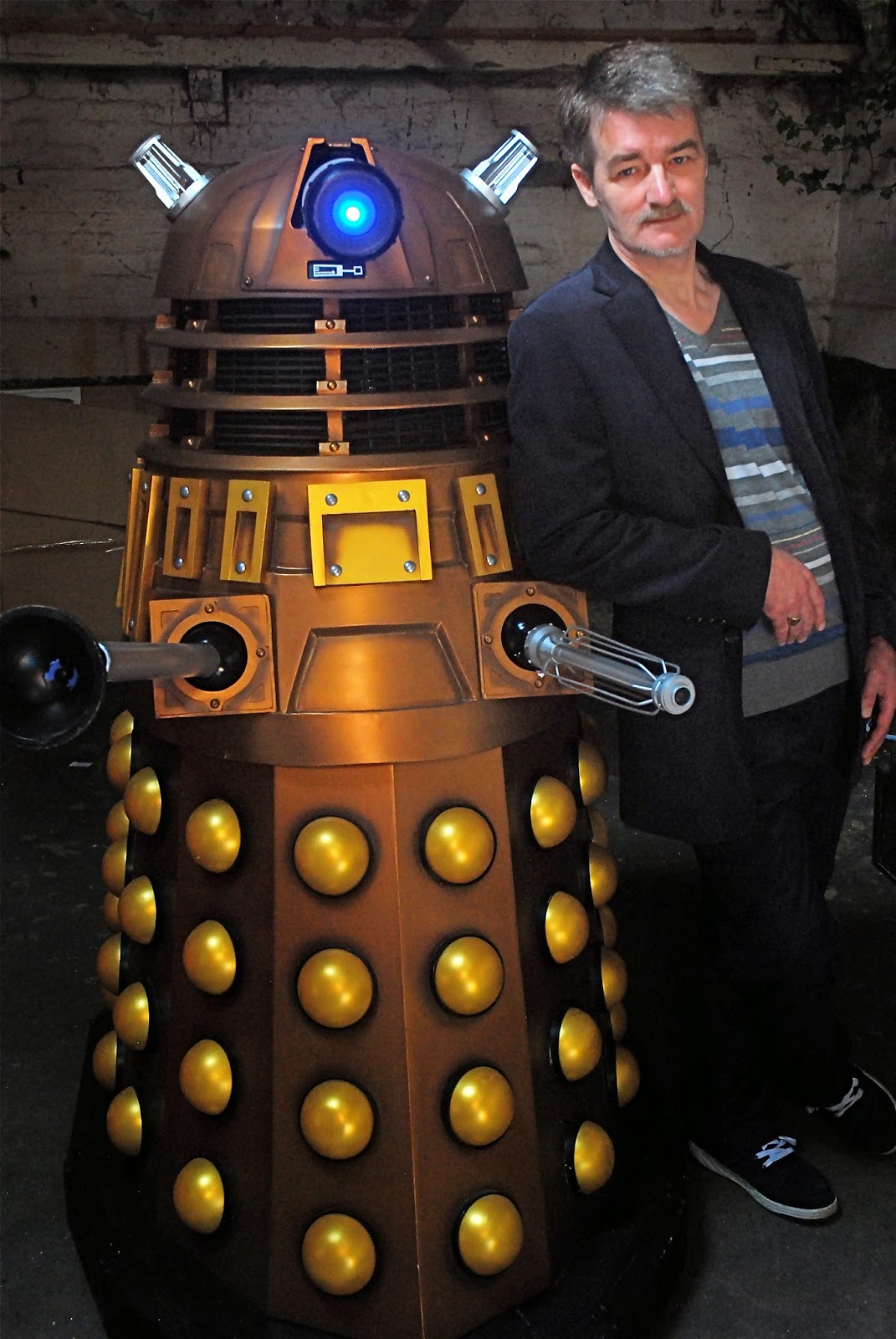
With the Daleks returning to our television screens this coming Saturday in the new series of Doctor Who in an episode titled Asylum of the Daleks, which is to feature every single Dalek that has ever appeared in Doctor Who from 1963 to the present, it promises to be one hell of an episode. But what was it about the Daleks that made them such an instant smash in the first place that the BBC kept bringing them back? Why were they so scary? And why, when they first appeared on TV all those years ago, did thousands of kids, of which I was one, hide behind their parents sofa, peeping nervously out from behind the arm-rest, to make sure it was safe to continue watching?  And why was it, when I did a photo shoot with a Dalek for the jacket of my David Tennant biography, did I feel like I was meeting a celebrity? 

It’s hard to describe why the Daleks were so terrifying. They were just metal boxes spinning round threatening to ‘exterminate’ people. But somehow it worked. Somehow they managed to impregnate the national consciousness and became the most terrifying symbol of destruction. Maybe it was the weird staccato voice. Maybe it was a fear of the Nazis on which they were apparently based. But whatever the reason, they were frightening enough to give most children nightmares in the 1960s.

To many, though, yes, it was their chilling speech - and their design. It seems quite remarkable today to think that if it wasn't for a combination of budget restraints and inspiration, the original Daleks, created by Terry Nation, and designed by BBC designer, Ray Cusick, they may never have seen the light of day. And even more remarkable is that if Cusick hadn't had come up the now familiar pepper-pot shape design, the ball-covered skirt, domed head and infamous sink plunger, the Daleks may not have been such a huge hit. In fact, it is a testament to Cusick's design that every time they return, they immediately captivate a whole new generation of fans.

When Doctor Who was once again broadcast in 2005, many fans hoped the Daleks would return to the programme. After much negotiation between the BBC and the Nation estate, which at one point appeared to completely break down, an agreement was reached. Written by Rob Shearman, ‘Dalek’, the sixth episode of Series One, was shown on BBC1 on 30 April 2005. The new Dalek exhibited new features, including a swivelling mid-section that allowed it a 360-degree field of fire and a force field with the ability to disintegrate bullets before they struck it. As well as being able to fly, it could also regenerate itself by means of absorbing electrical power and the DNA of a Time Traveller. The ‘plunger’ manipulator arm could now crush a man’s skull, in addition to the technology interfacing abilities shown by earlier models. When the Dalek fired in a wet, metal room, its laser conducted like electricity. The Doctor described it as a ‘genius’, able to calculate a thousand billion lock combinations in a single second and to download the entire contents of the Internet. A more sophisticated model of the Dalek mutant was also featured.

It seems everyone has a favourite type of Dalek, colour and design. What was yours?

Monday, 6 August 2012

In Search of Becoming an Actor

I was reminded last week of the time when I wanted to become an actor. Like so many others at the time, I thought the best way into the industry was by trying to get some work as a film extra. I had already looked into getting into drama school or joining a repertory company, but both were pretty prohibitive. Both the drama school and repertory company options presented financial hiccups. Neither I nor my parents had the finance to make it happen. And as my parents considered it the kind of career that was precarious to say the least, where you would spend more time out of work than in, I suppose the repertory company seemed the most ideal out of the two. But in the 1960s, local repertory companies would take young hopefuls on as stage hands, and if you were very lucky, you may end up with a walk-on part, but it was an almost impossible way to live unless you had some savings or came from a wealthy family. I think the going rate at that time was £5 salary per week and out of that you had to find your own digs, in the same town where the rep company was based, so it was pretty much of a no-no.

Then I came upon the idea of perhaps trying to get a job working as an extra in films. I seem to remember that some studios hired people for crowd scenes, so I did some research, wrote a few letters asking to be seen, and made some phone calls, and ended up getting an appointment with the casting director at MGM in Borehamwood. But even then, it was not that simple. All the casting director told me was that it was pretty much impossible to do anything without an agent and without an Equity card. Equity is the actor’s union and back then you had to be a member even to be picked to do crowd scenes in a film or television drama. The casting director knew such an agent who may be able to help, so from MGM I was sent back down into the West End of London where I would meet with the recommended agent and reiterated with her what I wanted to do. The agent told me the first thing I had to do was to get some casting photos done. It just so happened that I knew this photographic studio in Brighton, close to where I had an office job at the time, and so I booked a photo shoot. I don't think I could afford many prints, but I remember doing a whole session of photos with the photographer, who also owned the studio. We did a range of different scenarios in different outfits, from portrait to character shots. I remember it was quite a poky little studio but well equipped to get some professional looking pictures done. We got some good results, for what the London agent had requested. I sent off what I could afford at the time, but never heard and never got a call even to attend a casting audition, not even as an extra.

Many years later I joined an amateur drama group. I was cast in about nine plays in all. The rehearsals were about three months for each play, two or three nights per week, and then the run of the production was usually nine days long, opening on a Friday night and running through to the Saturday of the following week. It was hard work, and I don't think until then, I realised how gruelling it was to be an actor, but it was always good fun though and was a great taster for anyone who was thinking of becoming an actor. But by the time I joined the drama group I wasn't looking at it as a profession, just purely a hobby. When I was thinking of it as a career, I wasn't really interested in stage acting, I just wanted to act in films or television and that was one of the reasons I went off to MGM Studios in Borehamwood. That and thinking I may get onto see some the stages where films like Where Eagles Dare and Ice Station Zebra had been filmed, but I didn't. I got nowhere near the actual studios where they were filming. I got as far as the admin offices and that was it!

Tuesday, 17 July 2012

Demi 50


In the run up to Demi Moore turning 50 in November this year, I have now uploaded to MediaFire, a PDF of the notorious picture spreads she did for Oui Magazine in 1981 before she was a star, when she was just 18 years old and looking for ways to further her acting career. The PDF features all 16 shots that were used in the original magazine, all of which are very Playboy, provocative and feature Demi naked. The full story of the photo sessions are featured in my biography of Demi, which is now available for 99p at Amazon UK and $1.54 at Amazon US for a limited period only. 


You can download the Oui Magazine Spreads PDF here

Thursday, 12 July 2012

Free Stones

To mark the 50th anniversary of when the Rolling Stones played their first live gig at the Marquee Club in London in 1962, I have uploaded a free chapter from the ebook edition of my book on the Stones, which you will be able to download from the link below for an indefinite period. The book was the first illustrated biography I wrote. Published by Castle Communication and distributed by Penguin Books in 1995, under the title of  Jump Up: The Rise of The Rolling Stones, it was an oversized coffee-table softback, which is no longer available in print. It was re-released last year as an eBook, under license, by Andrews UK. The free chapter also includes Amazon and iTunes buy links for those interested in downloading the entire book. This download also includes a special photo section of six iconic images of the Stones from their early years, which is not available in the eBook.

You can download the free chapter here